The Case for Doing Less: Seven Small Limits That Let a Craft Habit Breathe
Photo: Unknown, CC0, via Wikimedia Commons
There is a particular kind of tiredness that comes from standing in front of your own craft cupboard. Not the pleasant tiredness of a long making session, but the flat, slightly guilty fog of too much: too many half-skeins, too many patterns saved, too many possible things you could be doing and are not.
We tend to prescribe more for this feeling. More storage, more inspiration, more commitment. I would like to make the opposite case. What most of us need is not a bigger practice, but a clearer one. And clarity, in my experience, comes from limits.
Why a limit feels like relief
A constraint is only ever a decision you have made once and no longer have to make. That is its whole power. When you decide in advance that this month you are working only in wool, you are spared roughly four hundred small judgements a week. When you decide that the next thing you make must be finished before anything new comes into the house, the January sales lose their grip on you entirely.
None of this is deprivation. It is the opposite: it is the removal of noise so that the pleasure of making has room to be heard. A craft practice should feel closer to breathing than to admin. Here are seven small rules I have found useful — take one, or take the lot, and try them for a month.
1. One material at a time
Give a month to a single material. A month of paper, a month of wool, a month of clay, a month of salvaged cotton. It sounds austere and turns out to be luxurious, because you stop skimming and start going deep. Four weeks of paper will take you through folding, cutting, collage, paste paper and simple bookbinding. Four weeks of wool will teach you more about gauge than a year of flitting between fibre and cotton and linen.
Buy nothing new to make it work. The point is to use what is already in the cupboard, thoroughly, until you know it.
2. Finish before you buy
One in, one out is the mild version. The stricter version, and the more interesting one, is simply: nothing new arrives until the current thing is finished. Not nearly finished. Finished.
This rule does something quietly radical to your taste. Half the projects you are tempted by will not survive the wait — and the ones that do are the ones genuinely worth making. Meanwhile, the jumper gets finished in November rather than sitting in a bag until 2029.
3. Work by hand
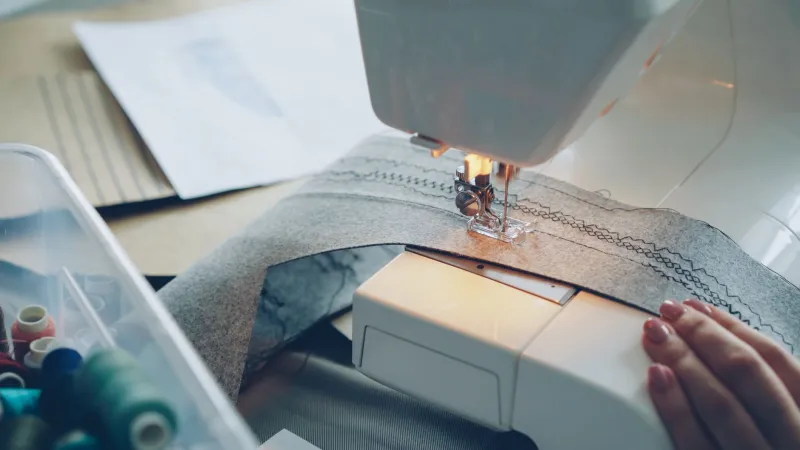
Put the sewing machine away for a month. Leave the die-cutter in the drawer. If a project can be done by hand, do it by hand, even though it will take four times as long.
This is not moral superiority about machinery; I own and love a sewing machine. It is that hand work runs at the speed of thought. You notice things. A hand-stitched hem teaches you how fabric behaves in a way that a machine, for all its speed, never will. And an hour of hand work leaves you calmer than an hour of almost anything else.
4. Make the same simple thing seven times
Pick something almost embarrassingly simple — a granny square, a pinch pot, a five-hole pamphlet stitch notebook, a plain calico tote — and make seven of them. Not seven variations. Seven of the same thing.
The first will be clumsy. The fourth will be competent. By the seventh, something interesting happens: the skill moves out of your head and into your hands, and you start to see what the form can do. Repetition is how every craft tradition on these islands was actually learned, and it is far more satisfying than novelty.
5. One basket, one project
Everything you are actively making lives in one basket. Not one per project — one, full stop. If it will not fit, something has to be finished or unpicked or honestly let go.
This one rule does more for a small flat in Manchester than any amount of shelving. It also stops the strange modern habit of having eleven projects in progress, none of which is being enjoyed.
6. Keep the hour, drop the goal
Commit to the time, not the outcome. Twenty minutes a day, or one evening a week, whatever is genuinely available to you — and then let the work be whatever it is. Some sessions produce six rows. Some produce a decision to unravel the last three.
Binding yourself to an hour rather than a finished object removes the low-level dread of falling behind on something you invented yourself. There is no behind. There is only Tuesday at half seven, and the lamp, and the wool.
7. Make it small enough to give away
If a thing takes six months, you will not give it away, and it will slowly become a monument. Make small things: a hot water bottle cover, a lavender sachet from a worn shirt, a mug rug, a little dish. Small enough to finish in two evenings and hand to somebody on a Saturday.
Making for other people is the oldest motivation there is, and it quietly corrects the urge to hoard. A craft practice that produces gifts stays generous and stays moving.
How to try this for a month
Pick two rules, not seven. Write them on a card and stick it inside the cupboard door, where you will see it before you buy anything. Choose a start and end date — say, the first of the month to the last — so it is an experiment rather than a life sentence. Keep a scrappy note of how it feels, not how much you made.
At the end of the month, ask one question: did I make more, or less, than usual? Almost everyone I know who has tried this finds the answer is more — and with less fuss attached.
What constraint is not
It is not a personality. It is not minimalism as an aesthetic, and it is certainly not a reason to feel virtuous. It is a temporary frame, and frames exist so that the picture has edges. Take yours down when it stops helping.
But do try one. The cupboard gets lighter, the evenings get quieter, and the making, oddly, gets bigger.